
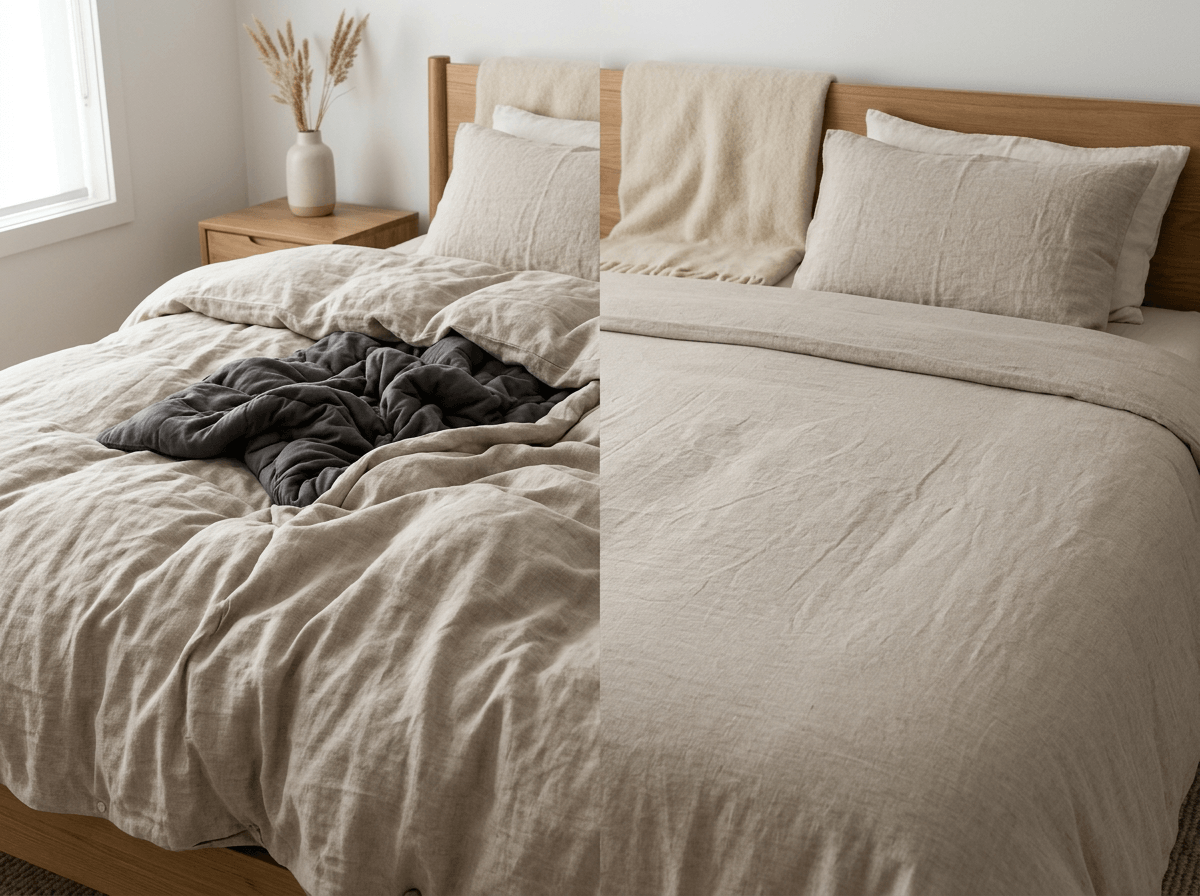
If your weighted blanket bunches inside the cover, the problem is usually not the blanket itself.
Most of the time, bunching happens because the cover is too loose, the blanket is not tied properly, or the cover was not made to handle the weight of a weighted blanket.
The good news: this is usually fixable.
Why weighted blankets bunch inside covers
A weighted blanket is heavier than a regular duvet. That means gravity pulls it differently inside the cover.
If the blanket is not secured well, it can slide toward one side, bunch in the corners, or twist during sleep.
The most common reasons are:
- the cover is too large
- the cover has no internal ties
- the blanket has loops but they are not used
- there are too few tie points
- the fabric is slippery
- the cover is not shaped for the blanket size
- the closure does not help keep the blanket evenly positioned
Step 1: Check if your blanket has loop points
Many weighted blankets have small fabric loops around the edges or corners.
These loops are there for a reason. They allow the blanket to be attached to a cover using internal ties.
Before buying or replacing a cover, check your blanket and count the loop points.
Common setups:
- 4 loop points
- 6 loop points
- 8 loop points
- 12 loop points
If your blanket has loops but your cover does not have matching ties, the blanket will move more easily.
Step 2: Use internal ties
Internal ties are one of the most important details in a weighted blanket cover.
They connect the cover to the blanket’s loop points and help keep the blanket in place.
Without ties, the blanket can move freely inside the cover. With ties, the weight is held more evenly.
For most standard weighted blankets, 8 ties are enough. For blankets with extra loop points, 12 ties can give a more secure hold.
Step 3: Choose the right size cover
A cover that is too big may look fine at first, but it creates extra space inside.
That extra space allows the weighted blanket to move, fold, and bunch.
Choose the cover by blanket size, not bed size.
Common weighted blanket cover sizes:
- 48×72 in / approx. 120×180 cm
- 60×80 in / approx. 150×200 cm
If your blanket is close to one of these sizes, choose the closest matching cover.
Step 4: Avoid slippery or overly loose fabrics
Some synthetic covers feel soft, but they can also be slippery. If the fabric slides too easily, the weighted blanket may move more inside the cover.
A fabric with more natural texture can help the cover feel more stable.
Linen is useful here because it has a relaxed, natural texture and does not feel as slick as many synthetic fabrics.
Step 5: Attach the cover correctly
When putting the weighted blanket inside the cover:
- Turn the cover inside out.
- Match each corner of the cover to the blanket.
- Tie the internal ties to the blanket loops.
- Work around the edges, not only the corners.
- Turn the cover back over the blanket.
- Shake and flatten the blanket evenly.
Do not only tie one or two corners. The more evenly the blanket is attached, the less likely it is to bunch.
Step 6: Check the closure
The closure should keep the cover closed, but it should not be the only thing holding the blanket in place.
The internal ties do the real work. The closure simply finishes the cover.
If the cover relies only on a zipper or open end, but has no ties, the blanket may still shift.
Best solution: use a cover made for weighted blankets
A good weighted blanket cover should be designed around weight, not just fabric.
WeightedLinen is made specifically for weighted blankets. It uses breathable European linen and lets you choose 8 or 12 internal ties depending on your blanket brand and loop layout.
This helps keep the blanket more stable inside the cover while giving it a more natural linen feel.

Need a cover that actually fits a weighted blanket?
FAQ
Why does my weighted blanket slide inside the cover?
Usually because the cover is too large, too slippery, or does not have internal ties connected to the blanket loops.
Do internal ties really matter?
Yes. For weighted blankets, ties help keep the weight distributed more evenly inside the cover.
How many ties should a weighted blanket cover have?
Many standard blankets work with 8 ties. Some blankets have extra loop points and may work better with 12 ties.
Should my cover be bigger than the weighted blanket?
No. It should be close to the same size as the weighted blanket. Too much extra fabric can cause shifting and bunching.
Can linen help with bunching?
Linen will not replace proper ties or sizing, but its natural texture can feel less slippery than some synthetic covers.